Reusing Reclaimed Barn Timber: Why It Beats New Material
Oct 14, 2026 · 4 min read
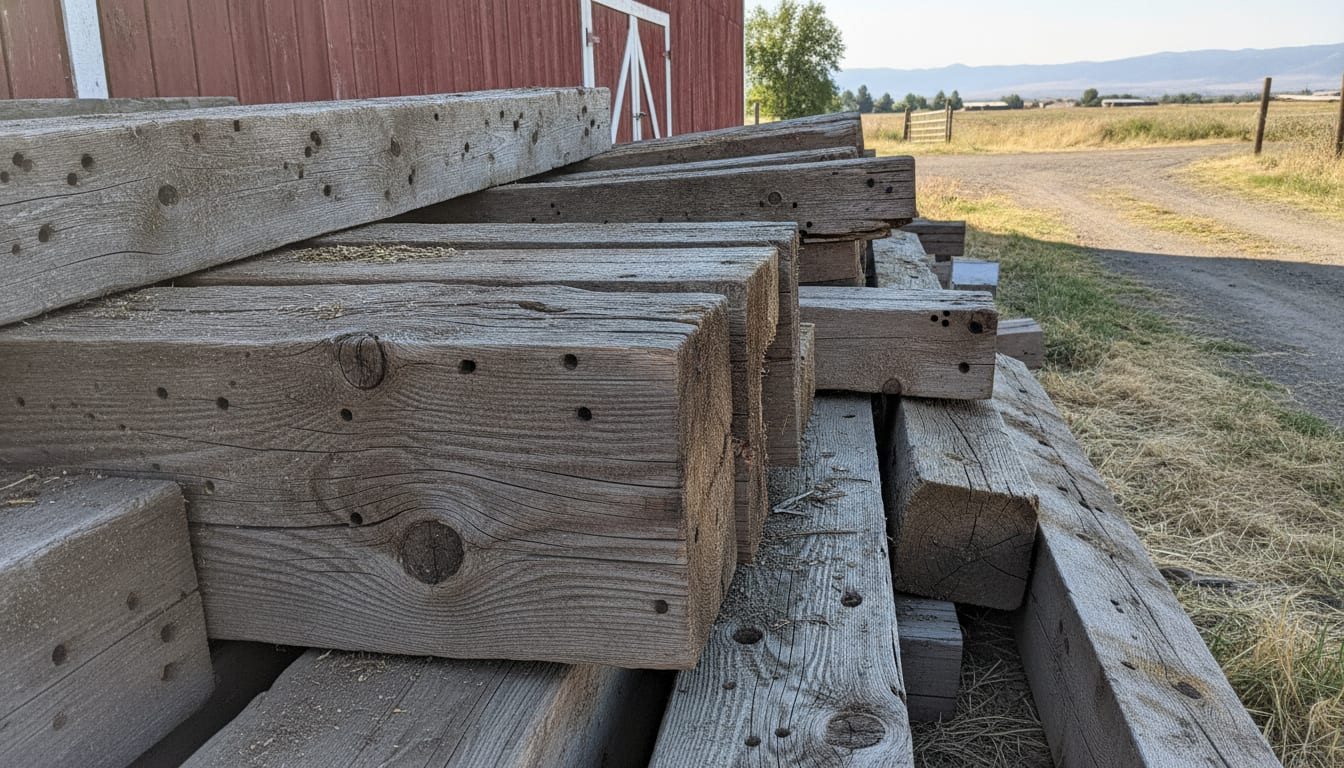
Drive out past Caldwell or Wilder and you'll pass old barns that have been standing for sixty, eighty, a hundred years. Some are falling down. Some are worth more standing than most people realize, especially the lumber holding them up. We get calls all over the Treasure Valley about barn renovation and new pole barns, and a question that comes up a lot is what to do with the old timber once a structure comes down or gets reworked. Our answer, more often than not, is use it.
Why old barn timber is often better than new lumber
Timber cut seventy or more years ago usually came from old-growth stands, with tight growth rings and dense, slow-grown wood. That wood has also had decades to dry out and settle. It doesn't shrink, twist or check the way a lot of new dimensional lumber does once it's installed. You're not buying green wood that moves on you after the fact — you're buying wood that already moved and stopped.
There's also the look. Reclaimed barn beams and siding carry weathering, saw marks, nail holes and color that you cannot buy off a shelf at any price point. On an accent wall, a mantle, exposed beams in a great room, or trim on a new outbuilding, that character is the whole point. New material can be stained to look old. It never quite reads the same.
Where reclaimed timber makes sense on a project
Structural reuse is case by case — Clete would need to look at the specific timber, how it was stored, and what it's being asked to carry before saying yes to using it load-bearing again. Rot, old insect damage and hidden splits are real possibilities on wood that's been exposed for decades. But there's a lot of reclaimed timber use that doesn't carry that risk: feature beams, siding, interior trim, barn doors, accent walls, fencing, and cladding on a new pole barn or shop. Those are places where reclaimed material looks right, costs less than buying premium new material, and keeps a piece of the old structure alive instead of hauling it to the dump.
This is working to a real budget, done right
This is a good example of what we mean when we say we work to a real budget. Reclaimed material isn't a downgrade from new — on a lot of jobs it's the better-looking, better-performing option, and it costs less than buying everything new from a supplier. If you're restoring an old barn instead of replacing it, doing a barn renovation in Wilder, or putting up a new pole barn or outbuilding anywhere from Melba to Parma to Marsing, it's worth asking what can be salvaged before anything gets torn out and hauled off. The same thinking applies closer to town too — a room addition on an older Caldwell home, a garage conversion to living space, or trim work on a 1990s Meridian renovation can all use reclaimed wood where it fits.
One call for the whole job
Most of the people we talk to about a barn or outbuilding project don't have one single question — they have a list. Save this section, rebuild that wall, figure out what to do with the old lumber, put up a new pole barn next to it, maybe fix a gate and a few boards while we're out there anyway. That's exactly the kind of job BelAir Construction takes on. We're a general contractor and a jack of all trades, based in Nampa since 1996, and we'd rather hear your whole list than just the one item at the top of it.
We work across the Treasure Valley — Nampa, Caldwell, Meridian, Boise, Eagle, Kuna, Star, Middleton, Melba, Wilder, Parma, Marsing and Emmett. If your town isn't on that list, it still might work out — just ask and Clete will confirm.
What it costs
We won't give you a number sight-unseen, and we're not going to pretend one means anything if we did. Every reclaimed timber project is different — the condition of the wood, how much cleaning and de-nailing it needs, what it's being used for — and Clete needs to see it in person to quote it properly. The visit costs you nothing but time.
Frequently Asked Questions
Is reclaimed barn timber safe to reuse structurally?
That depends on the wood and what it's being asked to do. Clete would need to look at the actual timber — checking for rot, insect damage and hidden splits — before saying whether it's suitable for load-bearing use. Non-structural uses like siding, trim and accent beams carry a lot less risk.
Can BelAir take down an old barn and build a new one using some of the same material?
Yes, that's a common project for us. We handle pole barns and outbuildings as well as barn renovation and repair, so reusing material from a structure that's coming down into a new build is something we can plan for during the site visit.
Do you only work on barns, or can you handle the rest of the property too?
We're a jack of all trades, so send the whole list. Fencing, gates, outbuildings, excavation and grading, and general property cleanup are all things we handle alongside barn and pole barn work, often in the same visit.
Want a real number on your job?
Clete comes out, looks at it and quotes it properly. Send the whole list.